
Compare Lawrence County Value Types
Know the type before you compare. Indiana assessments aim at market value-in-use under a 100 percent assessment ratio. A sale price is simpler. It is just the consideration for one past transfer, while a private appraisal carries its own effective date and purpose.
| Value type | Meaning | Record source |
|---|---|---|
| Gross assessed value | Land plus improvement assessment before deductions | Assessor card and Auditor tax record |
| Market value-in-use | Indiana assessment standard based on the property’s use | Assessor and DLGF guidance |
| Net assessed value | Tax base after applicable deductions | Tax duplicate or bill records |
| Last sale price | Amount tied to a prior transaction, subject to source details | Assessor sales, deed, or ratio study |
| Private appraisal | An opinion for a stated date and purpose | Not a county public value field |
Never place a net tax figure beside a gross assessment. An adjusted ratio-study sale is not recorded consideration either, so keep those columns apart.
Look Up Lawrence County Assessments
The Lawrence County Assessor keeps cards for all townships, and its GIS map searches by address, owner, or tax ID while returning sales information and a scanned card. An address can have more than one form. The parcel number is the safest cross-check.
- Search the address in Lawrence County GIS and confirm the parcel shape.
- Click the parcel point to open the scanned card and note its assessment year.
- Record land, improvement, and total assessed values separately.
- Compare any sale date and price with the deed or official sales record before using it as a benchmark.
If the portal fails, contact the Assessor in Room 25 at 916 15th Street, Bedford, or call 812-275-5405. Ask for the existing property card by parcel number.
Lawrence County's Value Record
The official Assessor page details property record cards, market value-in-use, sales information, and the GIS route.
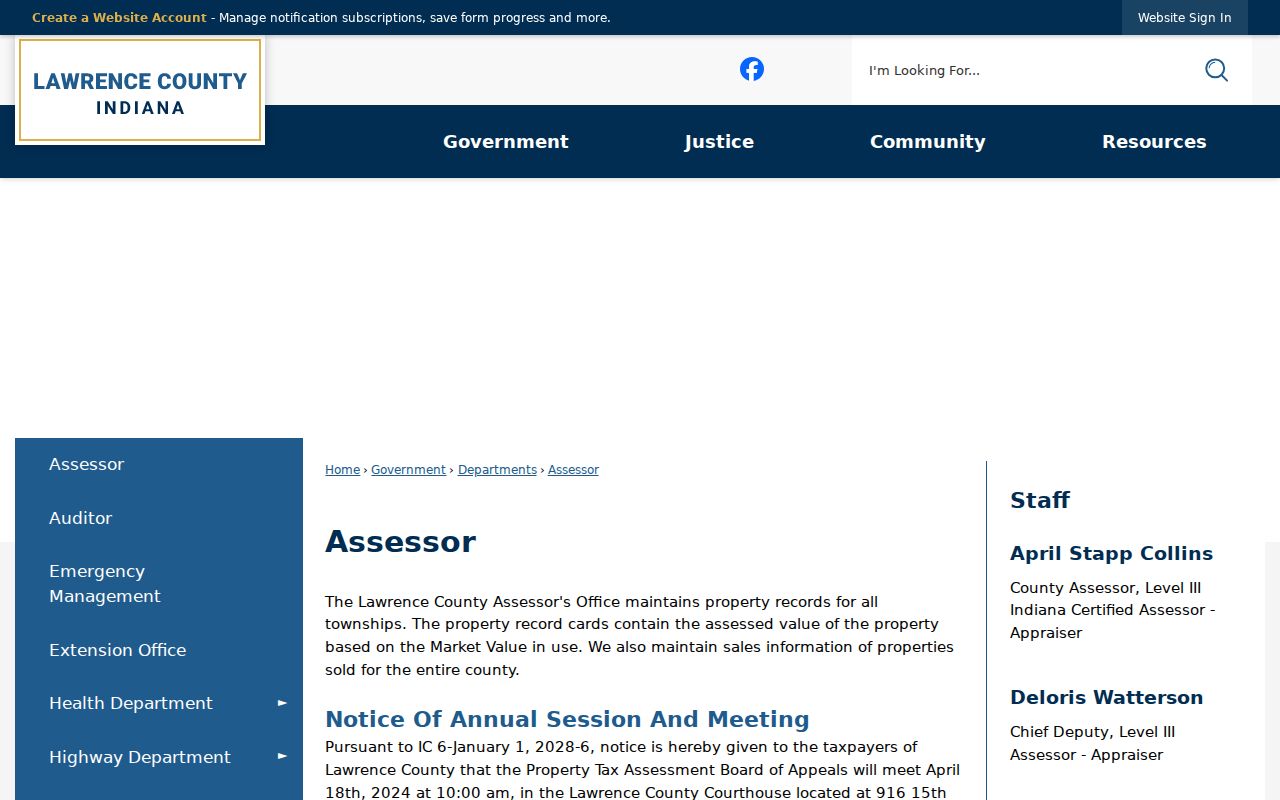
The county's own page anchors the source. The live parcel card must supply the actual year and value fields, since an office overview cannot show a current parcel amount.
Define Lawrence County Value Fields
Several similar labels must stay apart when comparing Lawrence County property value records.
- Assessed value
- The value used in the property-tax system, stated for an assessment year.
- Market value-in-use
- Indiana’s standard for valuing property according to its use.
- Assessment ratio
- The relationship of assessment to the relevant market measure; Indiana uses a 100 percent ratio.
- Sale price
- The amount reported for a transaction, which may need deed confirmation.
- Reassessment
- A review that may change parcel characteristics or assessed value.
Trending and physical reassessment are distinct, and a changed value does not prove a sale.
Why Lawrence County Values Change
Indiana dropped its old ten-year reassessment model. Values now adjust each year from recent sales. DLGF explains that annual trending draws on sales from the prior 14 months, so a parcel value can move without a new deed or an inspection in that exact year. A separate statewide cyclical reassessment adds physical review. It begins July 1, 2026 for 2026 Pay 2027. Roughly one-quarter of parcels are slated for inspection each year of the four-year cycle. Field review can update the characteristics that feed the assessment, and DLGF's cyclical reassessment page documents the statewide schedule.
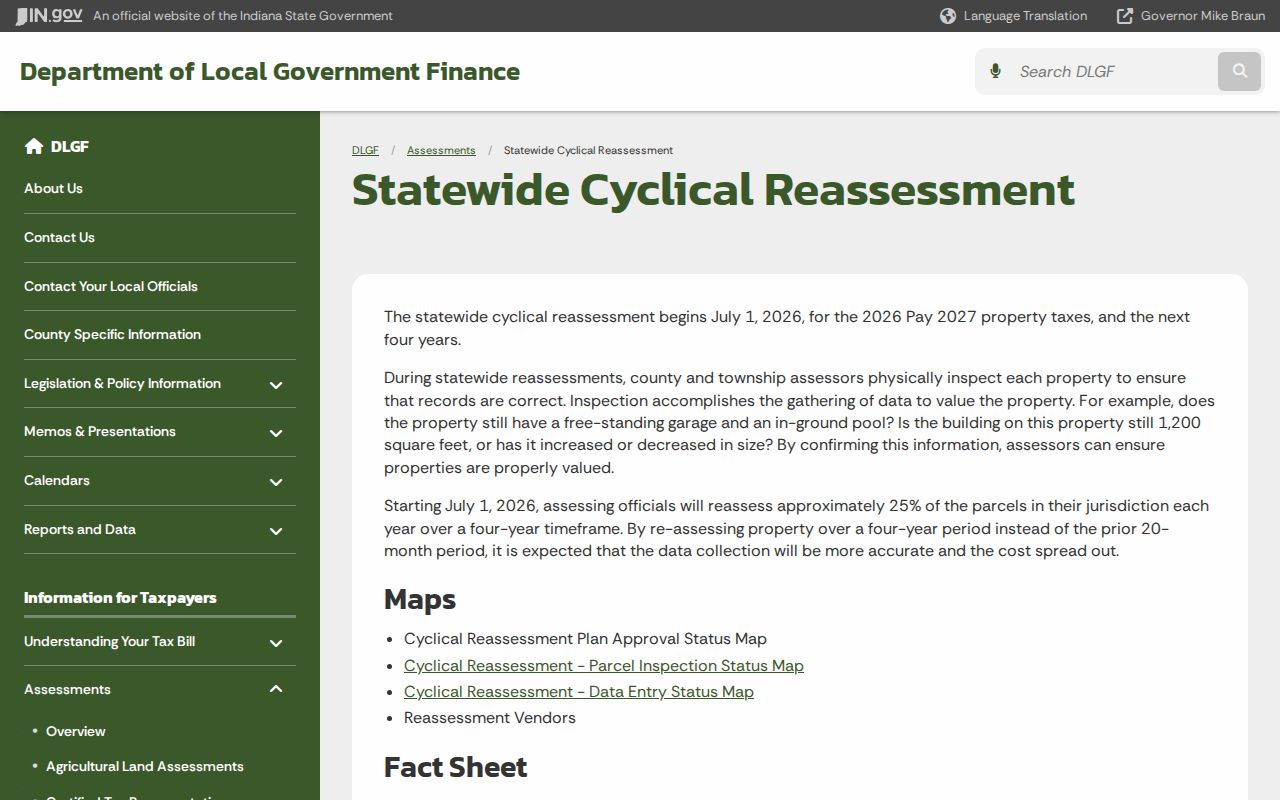
Ownership can stay the same. The state page explains why a future card may still show updated facts or value.
Read Lawrence County Sales Evidence
The Lawrence 2025 ratio study is an aggregate quality check. It is not a parcel appraisal. Its local schema runs deep. It lists parcel number, district, neighborhood code, class, land and improvement assessments for two years, sale date, sale price, adjusted sale price, and ratio. The study covered 14 sales. Its approval letter is dated May 6, 2025. The reported median ratio was 97.93 percent, and the weighted mean came in at .98. Those figures describe the study sample alone. They do not show that each Lawrence County property value moved by the same amount. Nor do they show that a parcel would sell at a set fraction of its assessment. Use the parcel card and transaction record for the individual property. Note: Keep reported sale price, adjusted sale price, and assessed value in separate columns. Compare them that way.
Deductions Do Not Reset Value
The Auditor handles Homestead, Mortgage, Veterans, and other deductions. A deduction trims the net assessed value used in the bill calculation. It leaves the gross land and improvement assessment untouched. A lower amount alone proves nothing. Nor does a GIS card show approval. Ask the Auditor for the deduction record or tax duplicate. Tax rates, credits, caps, balances, payment methods, and appeals belong to the tax process. They do not change the meaning of value fields. The Lawrence County property tax records page covers those steps. For value comparison, stop at the source, year, gross or net label, and sales context.
Limits of Lawrence County Values
An assessed value is a mass-appraisal result. It cannot weigh every condition a buyer, seller, or licensed appraiser might consider on a given date. A prior sale may be old. It may be non-arm's-length, adjusted for ratio-study use, or tied to a different parcel configuration. A deed amount may need context too. Check splits, combinations, assessment years, and legal descriptions first. Ask the Assessor about the card's components and the Recorder about a sale instrument, and seek a licensed appraisal when an independent market opinion is required.
Value is not price. A Lawrence County assessed value supports taxation. It is not a sale promise, listing price, or private appraisal.
Match Lawrence County Value Years
Indiana real property is assessable on January 1 each year. The tax itself is administered on a later cycle. Always write the assessment year next to the Lawrence County property value. A payment date or bill year will not substitute. Compare land, improvement, and totals from one year. Keep deed date, sale date, and ratio-study year separate. If a split or combination changed the tax ID, request the Auditor or Assessor split sheet before charting a value change, since otherwise the comparison may join different land areas.
Break Down Lawrence County Assessment
The county's ratio-study schema splits every assessment into land, improvement, and total columns. The split shows where value moved. It does not show why. A new improvement, a corrected characteristic, a trend factor, a physical review, or a split or combined parcel could all sit behind the change. So ask the Assessor for the dated card before drawing conclusions.
Treat neighborhood code and class as grouping fields. They are not zoning labels and not proof that two houses are true substitutes. Compare records that share use, date, parcel scope, and source. A nearby sale adds context. Still, no sale becomes a private appraisal without a qualified method behind it.
Log Lawrence County Value Sources
A good value worksheet gives each figure its own row. Log the parcel ID, assessment year, value type, amount, source, and search date. For an assessment, break out land, improvement, gross total, deductions, and net assessed value. For a transaction, break out sale date, recorded consideration, adjusted sale price, and deed reference. Leave blank fields blank. Guessing a number only contaminates the record.
That structure guards against one common error. It prevents setting a current assessment beside an old sale with no sign of the time gap. It also exposes when a split or combined parcel makes two totals incomparable. Keep the punctuation of a Lawrence County parcel number exact. That single key joins GIS, assessor, tax, and ratio-study records.
When a value change needs explaining, request the dated card from the Assessor. Also request the split sheet or tax duplicate from the Auditor. Ask one precise question tied to a field that exists. The offices will explain their own records. A public request, though, cannot compel a custom market analysis.
Test Lawrence County Sale Context
A recorded sale proves one transaction happened. It may involve related parties, only part of a tract, a changed parcel configuration, or terms a list cannot show. Match the legal description and the deed first. Only then use the price to judge a Lawrence County property value.
The ratio study reports sale price and adjusted sale price together, along with aggregate tests like median ratio, coefficient of dispersion, and price-related differential. Those measure assessment quality. They are not parcel-specific appraisals. Keep a local parcel result separate from a county study row, and always name which figure you are comparing.