
What Lawrence County Deed Records Convey
A deed is the instrument that moves the interest it describes. The Lawrence County Recorder files mortgages and many other documents too. Those do not all convey ownership. To read a deed properly, take the parties, the granting language, the legal description, the execution details, and the recording reference as one package.
| Recorded instrument | Effect to examine | Typical context |
|---|---|---|
| Warranty deed | Conveys the stated estate with written covenants | Ordinary sale or transfer |
| Quitclaim deed | Conveys whatever interest the grantor holds | Family or title cleanup |
| Trustee or executor deed | Conveys through a fiduciary acting under authority | Trust or estate matter |
| Tax deed | Records a transfer from the statutory tax-sale process | Completed tax-sale transfer |
| Easement | Grants a defined right without conveying the whole parcel | Access or utility rights |
Not every recorded document passes title. A mortgage secures a debt, a release can clear a recorded claim, and an easement may burden or benefit part of a parcel. Check the image itself, or ask the office for the file, before trusting an index label.
Two Eras of Lawrence County Deed Access
Online access came late to the deed books. The county-linked Doxpop service offers Lawrence County index entries. It also offers scanned images going back to December 1994. The Recorder, though, holds deeds and mortgages from the county's formation. So the online start date is not where the series begins.
Online cutoff. Search Doxpop for December 1994 forward, then use the Recorder's name index and deed books or State Library microfilm for earlier transfers.
A blank result is not always a dead end. The deed may predate online coverage, carry a different spelling, or sit behind a volume and page request instead. Modern and historic access are really two halves of one Lawrence County deed-records search.
Lawrence County Recorder Search Fields
Doxpop lets you search by party name, document number, book and page, date range, legal-description terms, and search region. The basic search form asks for a party name. The document-type dropdown for Lawrence County records shows its options in each returned row, so rely on the types displayed there rather than guessing.
| Index field | How to apply it | What to retain |
|---|---|---|
| Party name | Try names, initials, and spelling variants | Exact grantor and grantee text |
| Date range | Narrow around a known event | Recording date and time if shown |
| Document number | Open a known modern instrument | Full number |
| Book/page | Retrieve a cited volume entry | Both values |
| Legal terms | Match lot, block, addition, or land calls | Indexed wording |
Old name indexes rarely include a street address. A GIS map can give you the current owner of record and the legal description, which then bridge you to the right deed.
See the Lawrence County Deed Search
The official Doxpop party-name screen displays the region selector, the search controls, account messaging, and the Property Watch notice.
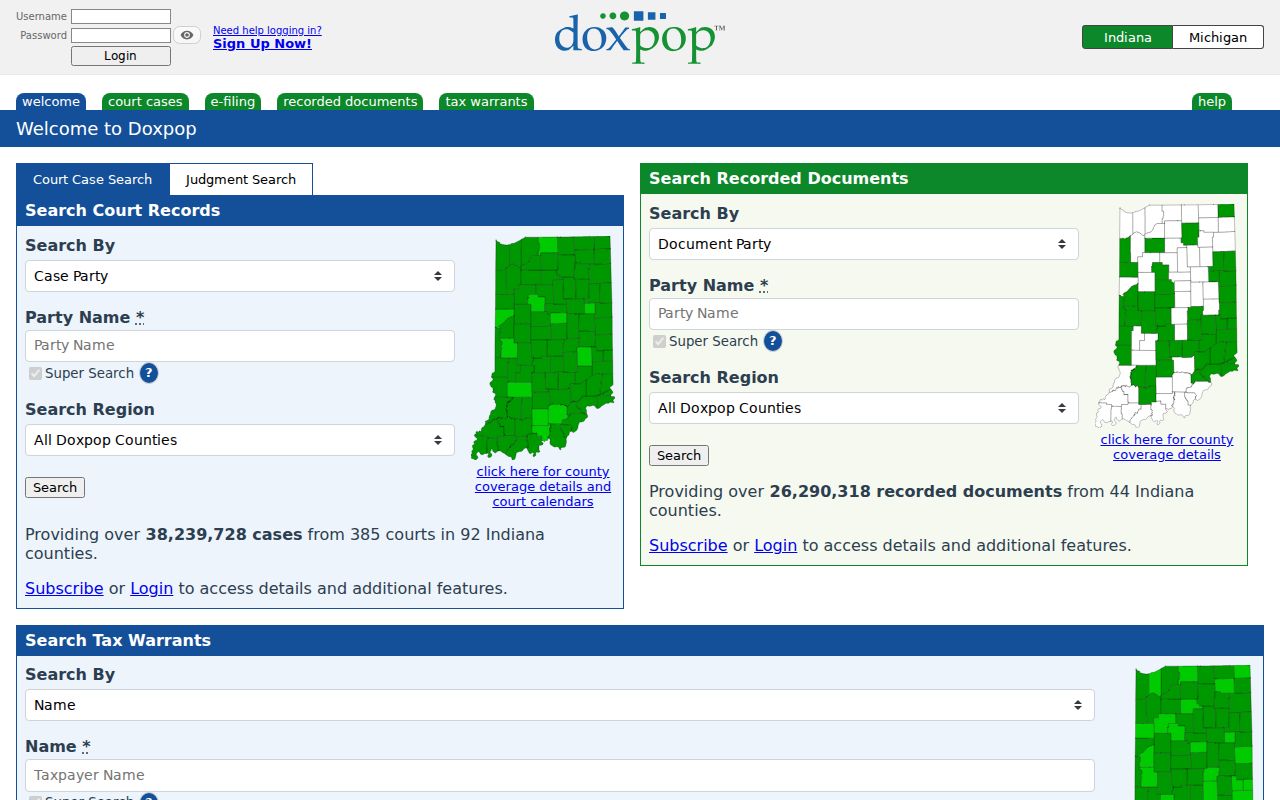
Doxpop is a vendor linked to the county, not the records custodian. The Lawrence County Recorder keeps the official deed files. Check current account and image charges before placing an order.
Follow Lawrence County Grantors and Grantees
A deed chain follows people, not just an address. Begin with the most recent owner name you trust. Locate that party as grantee on the acquisition deed, note the grantor, then search for that grantor as an earlier grantee.
- Find the current party's acquisition deed with that party indexed as grantee.
- Copy the grantor, date, document number, and legal description.
- Search that grantor as grantee to locate the earlier acquisition.
- Confirm that the legal description follows the same tract through any split.
- At the 1994 boundary, continue in office indexes, deed books, and microfilm.
- Grantor
- The party transferring the stated interest.
- Grantee
- The party receiving the stated interest.
- Chain of title
- The ordered sequence of recorded transfers affecting a tract.
- Recording reference
- The instrument number or book/page used to retrieve a document.
Log every step in its own row. A shared surname means nothing without a matching legal description linking the two transfers.
Capture the Full Lawrence County Deed Entry
A solid log records both parties, the instrument type, recording date, document number, book and page, legal description, and image status. Add the parcel or tax ID and the consideration only if the source truly shows them.
| Parties | Exact grantor and grantee spellings, including entity suffixes |
|---|---|
| Record key | Instrument number or book/page |
| Land text | Lot, block, addition, section, township, range, or metes and bounds |
| Related evidence | Sale or consideration reference only when shown |
| Access state | Online image, office copy, microfilm, or not located |
Never swap assessed value for consideration. And a parcel-map line is not the deed's legal description. Every source serves a different purpose.
Older Lawrence County Deed Books
The Indiana State Library county guide leads to Lawrence County deed indexes and microfilm. Published early runs include volumes A-B through I/K. The sequence shows no volume J, and that gap should be left as it stands. Use recording dates and predecessor citations to pick the right reel or book.
The 1926 plat book and the 1879 atlas can reveal additions or historic landowners. A map label is only a lead, though. Hutton Research Library folders, newspapers, maps, and photographs may explain earlier names. Recorder records should then confirm any transfer those sources suggest.
Current Lawrence County Recording Channels
Lawrence County deeds can now reach the Recorder electronically. E-recording began August 22, 2023 through approved providers. It is a submission channel for authorized workflows, though, not a public title-search tool. The provider handles delivery only. The county Recorder remains the custodian of the deed records themselves.
For anyone filing at the counter, the office posts hours of 8:00 a.m. to 4:00 p.m. There is a 3:30 p.m. cutoff for last recordings. Those times shape both counter access and same-day filings. Check the live county page before any time-sensitive visit or submission.
Obtain a Lawrence County Deed Copy
The Lawrence County Recorder keeps deed records at 916 15th Street, Room 21, in Bedford. Call 812-275-4139 or email Jallen@lawrencecounty.in.gov. Aside from military discharges, the office allows records to be viewed and printed, with office copies billed at $1 per page.
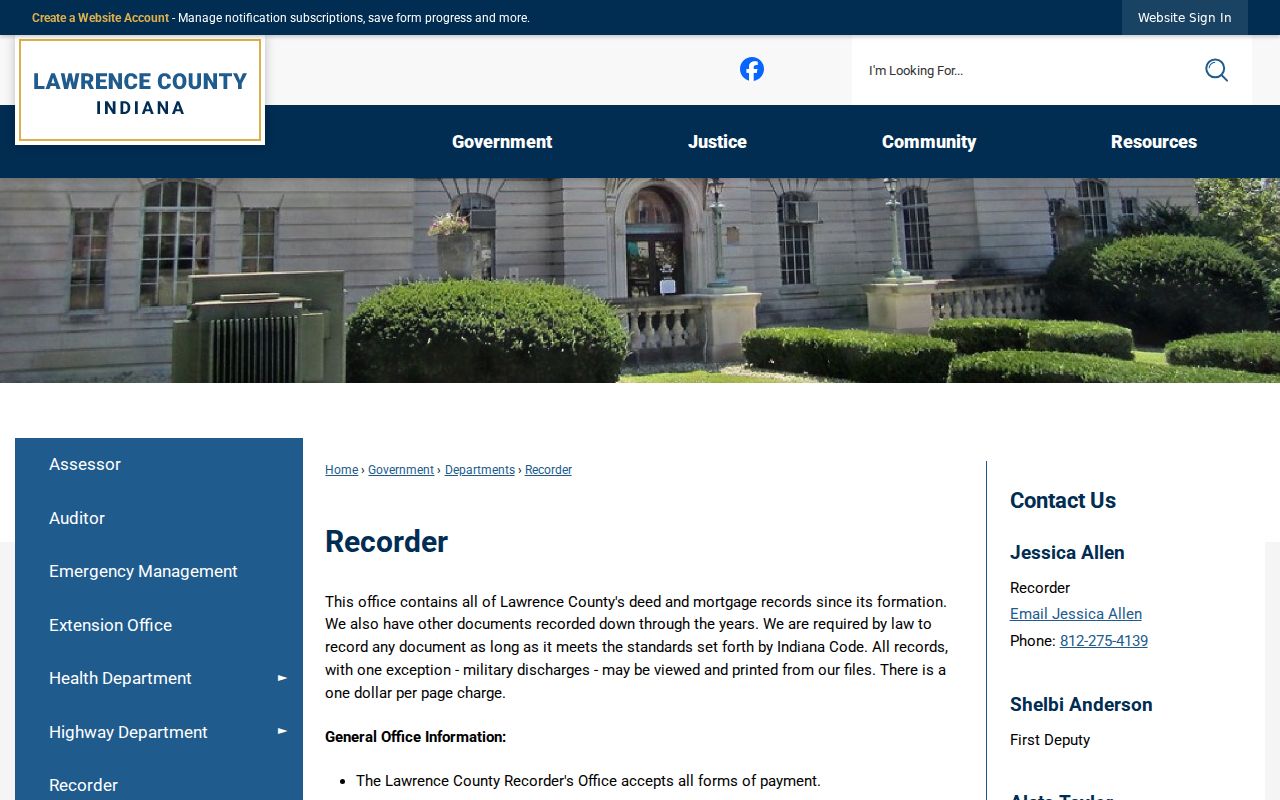
A name-only lookup by office staff is available, and Doxpop provides an online link. When you contact the recorder, give the party name, an approximate date, and any reference number, then ask which copy form fits your intended use.
Recorded, not guaranteed. Lawrence County deed records show filed instruments, but an index result is not a title opinion and cannot rule out unrecorded interests or indexing errors.
Request an Unlisted Lawrence County Instrument
Indiana's APRA, IC 5-14-3, gives you access to existing public records described with reasonable particularity. Identify the party, the parcel or legal terms, the document kind, and the date span. Do not ask staff to resolve a title question. Ask for electronic format and a cost estimate when useful.
If content is withheld or redacted, request the statutory basis. Response periods are not guaranteed production dates. Restricted records, such as military discharges, follow different rules.
For a complex chain, describe one missing link at a time. Give the named party. Include the approximate recording span. Add any known book, page, or instrument reference, and the legal-description terms. That frames your request as a real record rather than an open-ended research assignment.
Legal Descriptions Tie Lawrence County Deeds Together
The legal description ties one deed to the next. Names repeat, and they change through marriage and inheritance. The land description stays constant. So copy every term exactly: section, township, range, quarter-quarter, lot, block, addition, subdivision, and any mention of an alley, right-of-way, easement, railroad, creek, quarry, or monument. A street address helps with the GIS map. Older deed indexes often omit it entirely.
For platted land, match the lot and block to the named addition. Then match its recorded plat. For unplatted tracts, follow the metes-and-bounds calls and the predecessor-deed references instead. A later parcel may cover only part of an older tract. Note the split rather than forcing the old and new parcel numbers to match. The Auditor or Assessor can supply a split sheet. The Surveyor's maps and corner ties help explain the geometry.
Mortgages, Releases, Liens, and Lawrence County Deeds
Deeds share the Recorder's books with mortgages, releases, liens, and other instruments. A real search reaches past the acquisition deed. A mortgage never conveys what a deed conveys. A release must be matched to the specific obligation or instrument it discharges. An easement can outlast a change in ownership.
Record every related document under its own instrument number or book and page. A docket entry is not a parcel lien. A tax balance does not prove a tax deed either. A judgment, foreclosure, probate, partition, or bankruptcy case may look relevant. Use it as context first. Then confirm any recorded parcel effect through the Recorder. That way the chain rests on recorded land evidence rather than assumptions.
Lawrence County Deed History Beyond the Index
The Hutton Research Library holds local folders, maps, photographs, yearbooks, and family-Bible copies. It also holds 390 newspaper microfilm reels. These have been converted into a searchable digital database. These sources can surface an old street name. They can also reveal an estate notice. A construction announcement, a quarry link, or a former business tied to a tract can appear as well.
The library route shines when the index name is unknown. Search a dated notice or directory entry first. From it, extract the likely party and place name. Then test that lead against the Recorder's index.
Use the history to sharpen a deed query, never to replace the deed itself. A newspaper notice may name a seller or date. The recorded instrument still supplies the parties and the legal description. The 1926 plat book can likewise show township land ownership. Its label describes that historical source date. The chain of title must still be rebuilt through the relevant Recorder indexes and volumes.