
Fields in Lawrence County Property Tax Records
Values and property cards live with the Assessor. The Auditor builds the tax duplicates and plats showing ownership and assessed valuation, while balances and payments sit with the Treasurer. Those roles explain the record.
| Tax-record item | Meaning | Custodian |
|---|---|---|
| Gross assessed value | Land and improvement assessment before deductions | Assessor |
| Deduction | Approved reduction used to reach net assessed value | Auditor |
| Tax district and rate | Local rate applied per $100 of assessed value | Auditor and Treasurer |
| Bill and status | Amount billed, paid, due, or delinquent when displayed | Treasurer |
| Parcel key | Identifier joining the tax row to the card and map | County systems |
The assessment ratio is 100%. Indiana applies it under the market-value-in-use framework, so an assessment is not the parcel's last sale price, and a tax bill is not a market appraisal.
Search Keys on the Lawrence County Tax List
The county tax-list form accepts district, parcel number, name, tax year, and property address. Keep entries lean. The instructions warn against overfilling the form and suggest a last name across the two latest years after a split or combination.
| Control | Use | Caution |
|---|---|---|
| District and parcel | Narrow exact tract | Preserve punctuation and district |
| Name | Find a billing row by last name | May show the prior-cycle owner |
| Tax year | Choose the bill period | Do not confuse with assessment date |
| Property address | Find a known site | Mailing and situs addresses differ |
| Maximum results | Limits the displayed return | A broad result is not a complete conclusion |
The page says "Not for Official Use." Keep that warning, plus the live update date, with any result you plan to use.
Read a Lawrence County Tax Bill in Order
Start with the parcel, not a sale price. Then pull the official tax row, card, deduction record, and rate for that same year before trusting any figure.
- Search by parcel or property address and confirm the district.
- Record the selected tax year, billing name, and update date.
- Compare gross and net assessed values with the Assessor card.
- Confirm deductions with the Auditor rather than assuming a card proves approval.
- Direct balance and payment questions to the Treasurer.
- Assessed value
- The value placed on the parcel for the assessment system.
- Net assessed value
- Gross assessed value after applicable deductions.
- Tax rate
- The local rate applied per $100 of assessed value.
- Tax lien
- A claim for unpaid tax that must be confirmed in the proper record.
Why a Lawrence County Tax Name May Lag
The Treasurer bases the owner of record on who held the parcel on January 1 of the previous year. That timing explains the lag. A newly recorded deed can name a new grantee while the tax records still bill the former owner for the active cycle. The rule follows the calendar.
Three dates matter. Keep the January 1 assessment date, the bill's tax year, and the portal update date separate from the deed recording date.
For a purchase after January 1, the county advises searching under the former owner and asking the title company about payment responsibility. This is tax administration, not a title decision.
Lawrence County Deductions and Office Roles
Deduction questions in Lawrence County start with the Auditor. That office handles Homestead, Mortgage, and Veterans deductions, along with every other exemption a property owner might claim. Rate questions also land on the Auditor's desk at 812-275-3111. The Assessor takes valuation questions at 812-275-5405, and the Treasurer sorts out balances and payments at 812-275-2431. Each office keeps its own slice of the property records, so the right call saves time.
Indiana's Tax Bill 101 chain moves from gross assessed value to deductions, then to net assessed value, the local rate, credits, caps, and finally net tax. A single deduction that goes missing can shift the whole bill without touching the parcel's gross value. Confirm filing status with the Auditor directly rather than guessing from another portal.
Lawrence County Payment and Parcel Changes
The Lawrence County Treasurer page lists online payment with a fee, phone payment at 1-888-654-3143 using the property number, in-person cash, check, or money order, and a drop box. Phone payments carry a fee too.
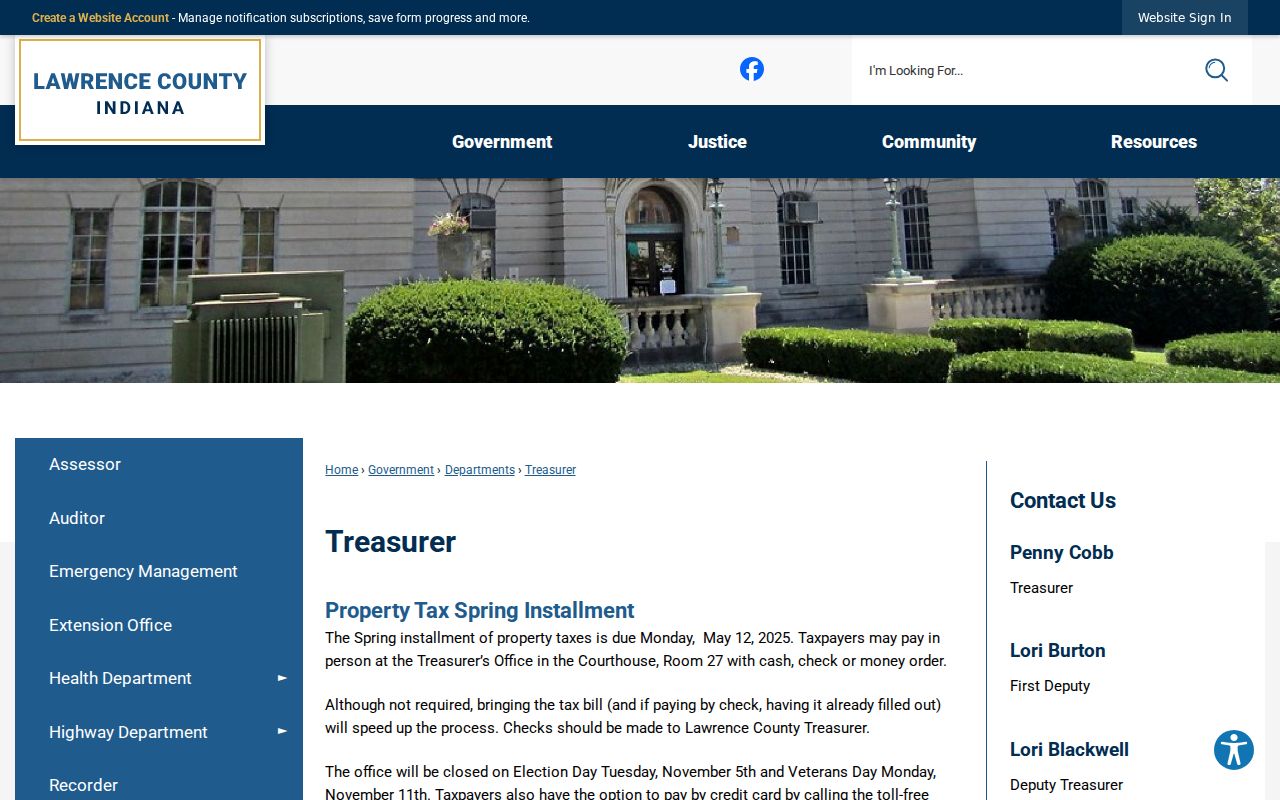
The same page explains the prior-January-1 owner rule and sends owners of split or combined parcels to the Auditor or Assessor for a split sheet. Confirm current service fees before paying.
The 2026 Lawrence County Reassessment Context
The state reassessment clock is running. Indiana's 2026-2030 cyclical reassessment began July 1, 2026 for 2026 Pay 2027, physically inspecting about one-quarter of parcels each year over four years alongside annual trending.
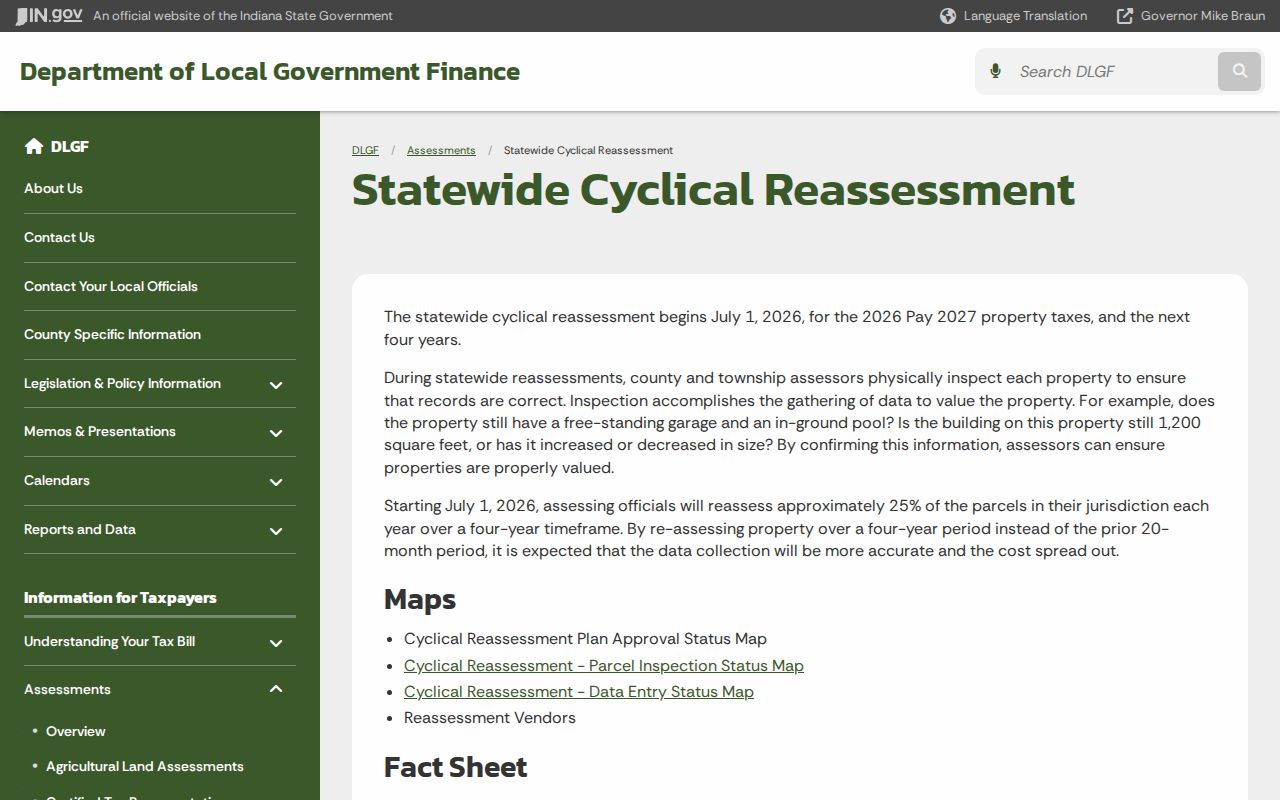
That schedule is why a Lawrence County property card can change from annual adjustment, physical review, or both. Note the assessment year whenever you compare values.
Contest a Lawrence County Assessment
The Indiana Department of Local Government Finance names Form 130 as the Taxpayer's Notice to Initiate Appeal. Start with the local Assessor. State guidance ties a June 15 contact point to receipt of Form 11, with a different rule when no Form 11 arrived. Confirm the applicable year and current instructions.
Confirm the filing rule. Contact the Lawrence County Assessor and use the current Form 130; a phone conversation alone may not open a formal appeal.
Good evidence starts with the parcel card. Add photographs, comparable sales, and the notice itself. The Lawrence 2025 ratio study reviewed 14 sales in aggregate, so it does not replace the parcel's own assessment record.
Delinquent Lawrence County Property Tax Records
A current balance, a certified delinquency, a tax-sale certificate, a redemption, a tax deed, a sheriff sale, a judgment lien, and a release are separate events. They can sit in separate systems. The Treasurer's site links payment, SRI tax-sale information, and sheriff-sale information. No parcel list or sale calendar appears there. Treat the tax list as a lead. Save its "Not for Official Use" warning too. Before acting, confirm the sale year, parcel list, minimum bid, redemption terms, and payment rules. Do this through the current county route. A delinquent balance alone does not prove a tax deed has issued.
If the question is a recorded tax deed, lien, judgment, or later release, take the Treasurer's lead. That lead points to the Lawrence County Recorder. Court records can add context. Bankruptcy dockets can too. Still, a docket event does not automatically prove a recorded lien against the parcel. Match the party, parcel, dates, and instrument before describing the legal effect.
Request Lawrence County Tax Material Offline
Online tools are not the only route to Lawrence County tax records. The Treasurer sits in Room 27 at 916 15th Street in Bedford. That office keeps weekday hours of 8:00 a.m. to 4:00 p.m. The Assessor works out of Room 25 in the same building. For deductions, rates, duplicates, and ownership plats, the Auditor is the office to ask. Indiana's APRA gives anyone the right to request an existing record. Name the parcel, the address, the tax year, and the exact field you want. Ask for electronic format and a cost estimate when that helps. The office has no duty to build a fresh calculation or chase a broad research question. The statutory response window is not a same-day promise.
Interpret Lawrence County Assessment Numbers
Indiana assesses at a 100% ratio under a market-value-in-use standard. Annual trending leans on recent sales. A physical review can change the facts on a parcel card. The state terms page explains that rates apply per $100 of assessed value. It also notes that trending draws on sales from the prior fourteen months. Those ideas frame the bill. They will not let you rebuild it from a single figure.
The local 2025 ratio study covered land, improvement, and total assessments for 2024 and 2025. It also listed sale price, adjusted sale price, and ratios. Its fourteen-sale summary put the median ratio at 97.93% with other statistical measures alongside. That sample describes one dated study, not a universal multiplier for Lawrence County property records. Trust the parcel's own card and tax year instead.
Track a Lawrence County Split or Combination
A division or merger of land can leave an old parcel number off the current tax roll. The old number may still sit on past records. Search the owner surname for the past two years, as the Treasurer suggests. Then ask the Auditor or Assessor for a split sheet. Log the old and new parcel IDs on their own lines. List the affected tax years, the legal descriptions, and any carryover balance the same way. Splits also answer other puzzles. One deed may seem to describe more land than the current card. Or a payment may look tied to a retired number. Never move an old balance or deduction to a new parcel by guesswork. Route payment allocation questions to the Treasurer. Send duplicates and deductions to the Auditor. Take the current assessment tract to the Assessor.
Keep Lawrence County Tax Evidence Current
Recheck before you rely on any tax result. Confirm the tax-list update date, the selected year, and the current rate table. Then check the payment status. Keep the search date in your notes. A printed screen can go stale. A payment, a corrected assessment, a deduction change, a parcel split, or the annual adjustment can each change what it shows. For certified or transaction-sensitive answers, go to the custodian rather than a portal printout. The county tax list itself warns against official use. A title company, an attorney, or a county office can say which certified record fits the task. Parcel and year homework makes that request easier.
Note: Keep the payment receipt apart from the assessment card and tax duplicate. Each proves a different fact at a different point in the cycle.